For my current mandolin build, I set out to answer 2 questions: 1. Whether to use physical deflection or frequency analysis to measure stiffness, and 2. How well can I measure wood quality in rough sawn form? (T. Gore says it needs to be planed smooth and rectangular for frequency analysis.) I have 4 different topwood species available for my current build: California Sitka, Englemann, Lutz, and Coastal Redwood. The billets range from 37…
PPP7 replies
7 replies
LikeShare
PPrivate member
Hello Neil, I also measure wood properties when I build mandolins and what you did is very similar to what I have tried, so I'd like to share some thoughts and comments. From my engineer point of view,…
Hello fellow looths! I recently had a customer come in with a '71 Fender neck that is a fusion of the 60s and 70s style. It has a veneer fretboard, no skunkstripe, 4 screwholes, 70s style tuners, 70s headstock logo, and it seems like it has a poly finish on the back of the neck, and nitro (with cracking) on the front of the headstock. Can anyone tell me if this combination is possible or could it be fake? Another thing is, even without th…
Hey Tony, thank you for your info, and sorry for the late reply. I don't spend much time in the loothgroup.. You have an amazing setup! The sheetmetal underneath is genius! I have to build something li…
I attach my necks using the LMII/O'Brien jig. No matter the method, there is no guarantee that the neck block and edge of the rim at the top is truly perpendicular to the centerline of the guitar.
I’ve just flossed when things weren’t quite right.
But now I take a long square, place it on the rim at the neck block and measure where the long square aligns on the top seam. I note Bass/Treble deviation at a known point (I use 290 mm).…
I have a red-label Yamaha FG-180 that’s in overall nice condition, but the neck angle is poor and the heel is already cracked. I’d like to attempt a neck reset, but I’m unsure how to proceed given the existing crack. Should I approach the reset as usual, or plan an alternate method because of the damage? Has anyone here tackled a reset on a guitar with a pre-existing heel crack? I know a crack can develop during the reset process, but I…
It was only a matter of time before one of these arrived on my bench. The neck on this 71 SG Deluxe is caving through to the neck pickup cavity— In a similar fashion to what happens on old jr’s. Both sides of the cutaway have cracks that extend through to the pickup route and I can flex them easily. Problem is that the cracks are not straight and wander all over. I worry about being able to get enough glue in there because of this. Thin…
I'm not sure what that would get you other than access to more gluing surface, which aint nothing, but unless you have some whack-a-doo grain orientation, isn't why that broke in the first place. Also…
I've been trying to figure out an easy to use jig that will allow me to clamp a top and back fast, so that I can use hot hide glue. No way with my spool clamp method I could ever get everything clamped in time. I thought about trying to use pneumatic cylinders with 3D printed perimeter feet, but that seemed very complicated and a lot of work to get something to attach the pneumatic cylinders to. But it kept coming back to me that usi…
Dude. That looks pretty cool? Have you thought about making an arch with an ACME screw to just throw center pressure on it? Like a book binding press etc?
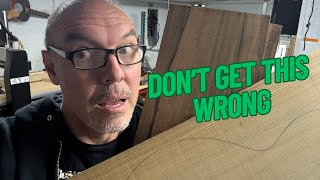
Hey folks, I put together a video showing how I measure the long, cross, and transverse frequencies on guitar top plates before thicknessing, following the Gore method. I also walk through using the calculator I built (based on Trevor Gore’s equations) to get target thickness and track density / young's modulus. Fair warning: the video’s a bit YouTube-y in tone thumbnail faces, a little energy for the algorithm, but the content is genuine…
PPP3 replies
3 replies
LikeShare
PPrivate member
Rick, this is amazing! Thank you so much for creating it and sharing it. I have Trevor’s books but having a calculator to run the equations is really fantastic.
Wondering what methods people use for tracing the shape of a cavity to make new covers, backplates, or switch-plates? Attaching a photo example of a battery cavity that's missing a cover and wondering what the best way would be to trace and reference the size so I can transfer it to a cardboard cutout and eventually cut a piece of wood to cover the cavity?
In the old days I would have done an etching. Tape off the paper really tight and then use mechanical pencil to rub around the edge. Now I would lay that on my office printer with a 6 inch rule, scan…
What kind of pore filler do you use? I usually use aqua coat, shellac/pumice or stewmac water based mahogany grain filler. Interested in other methods, including zpoxy.
I have similar thoughts to what you shared. On mahogany, aqua coat looks great. Unfortunately it left white residue in pores when I tried it on walnut. Now I’m curious about gluboost, thanks for the t…
I rarely use pickguards on my builds, as most of my guitars are intended for fingerstyle players. That said, I occasionally need to install one, and I've yet to find a cutting method that consistently meets my quality standards. I’ve experimented with several techniques for cutting clear pickguard material, but the results are always somewhat disappointing. Using a brand new X-Acto blade gives a reasonably clean cut, but there's almost a…
PP3 replies
3 replies
LikeShare
PPrivate member
I use raw pickguard sheet material, apply 3M 468MP Double Sided Adhesive Transfer adhesive sheet and trim to rough size with scissors or blades, depending on the pickguard material. I then attach to…
Hello fellow looths ! I'm deciding on a repair method for the jack recessed/angled hole on this Aria Pro SB bass. What kind of direction would you take ?
PP4 replies
4 replies
LikeShare
PPrivate member
Thanks guys ! I'll definitly add wood thickness and use a longer jack then !
Hello good people, My shop’s in Quebec City, so I get to repair an ungodly amount of cracks thanks to our brutal winter and customers being largely unaware of the requirements of maintaining proper RH. Now for the first time (call me lucky) I have two very good guitars in the shop whose cracks won't close up after having been rehumidified for a few weeks. I have tried over-humidifying and it does it, but once returned to proper RH (50%)…
PP14 replies
14 replies
LikeShare
PPrivate member
Thanks Dave, I'll dive back into Pat's book to see if he covers his technique in there.
Please can I see some quick cauls for dealing with fret pressing at heel transitions? For pressed / glued in frets or clamping down lifting fret ends in this area. I’ve tried a few different methods now and not entirely happy with any of them
I've been testing all my top and bracewood to find the best combination of stiffness and density, optimize plate thickness, etc. I started with Nicoletti's spreadsheet which calculates both stiffness and density, but since I was also testing deflection, I decided to compare the flexural modulus using that method (with the formula from T. Gore's book) on the same plates and bracewood. Unfortunately, I'm having trouble getting a satisfa…
PPP7 replies
7 replies
LikeShare
PPrivate member
Hello Neil, as you rightly pointed out, they are all in reasonable range for the species, but do not perfectly correlate (at least, not all of them). In my experience, the deflection method is is not v…
Hi everyone, I’m messed up, dinged a guitar and now I need some advice. I was relocating a screw hole in the top of a capri orange Mexican made telecaster when my drill bit broke and I punched an extra hole in the guitar top. 🤦 I called the owner and told him what happened and he’s going to let me try and fill it in. I don’t do much finish work so I’m not sure what the best method would be. I’m considering gluboost and their MasterTint pr…
PP2 replies
2 replies
LikeShare
PPrivate member
Hey Al, thank you for the suggestion. I think I'll give it a shot with the wast systems epoxy. I'll update you with how it goes.
I have built a steel string guitar that has an annoying high pitched pulsing overtone. The guitar is an x-braced OM style with a thicker depth (more in line with a dreadnaught depth). I have built several of these that do not have the annoying overtone, so I don't think its the specific shape that is causing it. The overtone occurs when the note B2 is played on the G string, 4th fret. Interestingly, it does not occur when the open B stri…
A bit hard to tell from your description, but is what you are describing as an oscillation a beat frequency? If so, it is possible you have multiples of two resonant frequencies that are nearly colli…