A Fender Bass Truss Rod That Just Spins
LikeCommentShare
Search the Hub or by author, or tap a filter to narrow the feed.

 Lite members only
Unlock video
Lite members only
Unlock video

 Lite members only
Unlock video
Lite members only
Unlock video

 Lite members only
Unlock video
Lite members only
Unlock video


 1 reply
 2 replies
 3 replies


 Lite members only
Unlock video
Lite members only
Unlock video

 4 replies
 1 reply

 1 reply
 2 replies

 Lite members only
Unlock video
Lite members only
Unlock video
I've built a number of classical guitars with an adjustable neck and they seem to gather quite a bit of interest, so i'm currently in the process of looking to refine the design and build.
It's quite a simple construction where the neck is held together by string tension and hangs on a pivot. I developed a 3d printed "socket" which acts as the interface between the body and the guitar and allows for some fine tuning of the alignment of the neck to the body. The adjustment is done via a 3mm allen key through a small hole in the fretboard. It's basically an adaptation of the method used by Greg Smallman and Garreth Lee.
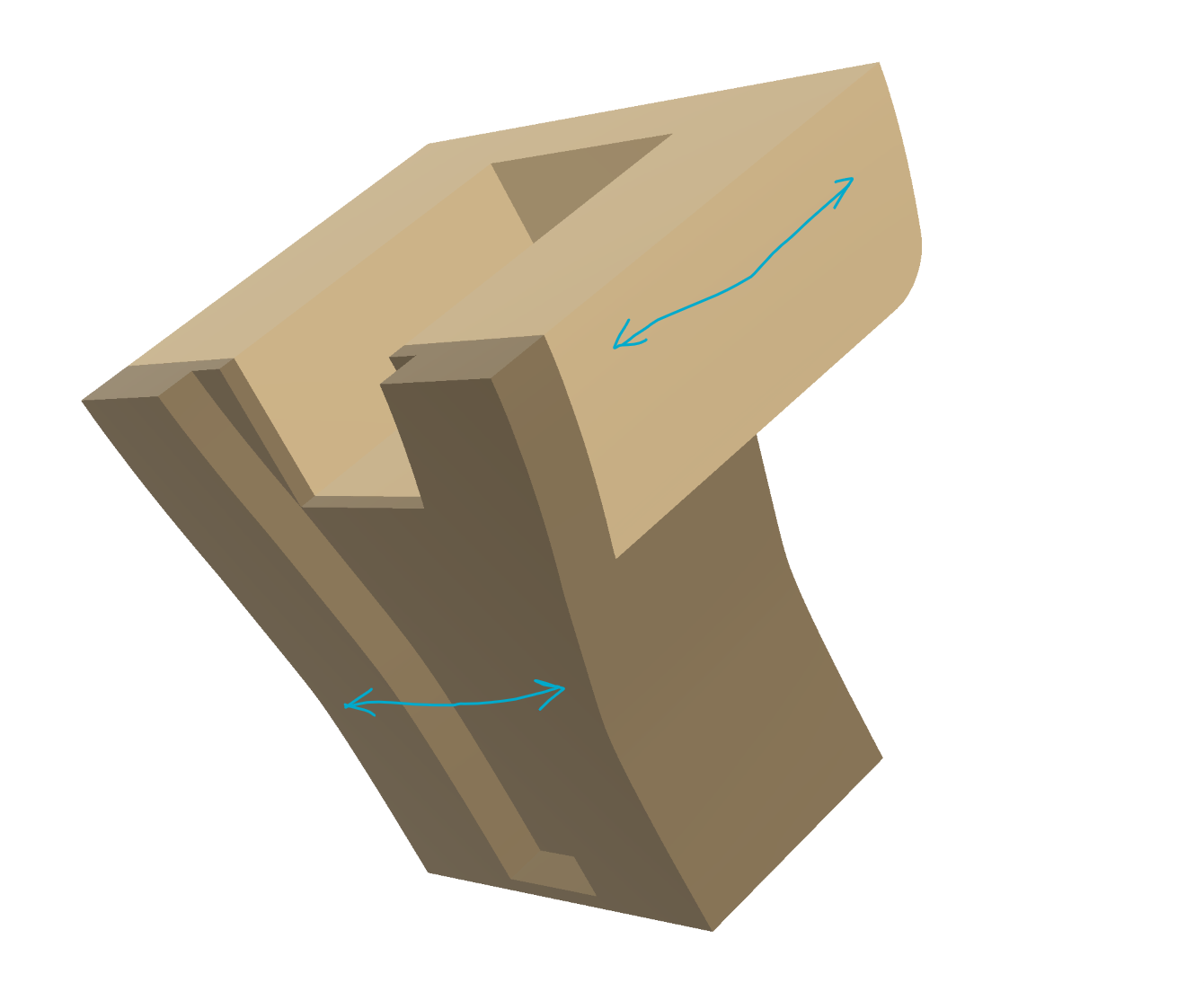
The neck block that I have built so far is an adaptation of Trevor Gore's bolt on neck, however I am questioning whether I can improve on the grain orientation. The original Gore design consists of 2 parts - a top part where the grain is parallel to the neck/soundboard, and a bottom part where the grain is parallel to the ribs.
Since, unlike a bolt-on neck, the neck is not fastening down the sides, I adapted the design so as to extend the bottom part to cover the entire back part - this way no part of the ribs are glued to the end grain.
So far, the guitars I have built had a spruce top part and Spanish cedar or African mahogany bottom part (to keep everything as light as possible - which is desirable on a classical), but considering an all Spanish cedar/mahogany build.
I am wondering if anybody has suggestions - particularly on the grain orientation or wood to use for an optimal result, or perhaps can spot any potential weaknesses with this design which i have not yet seen.
Thoughts :
Grain orientation in line with the ribs sounds like a good idea in terms of gluing integrity - particularly because there is no neck fastening the ribs to the body from the outside - in.
Grain orientation of the top block sounds like a good idea so as not to introduce additional stress on the soundboard with such a large block glued cross grain
However there is anyway a cross grain joint between the two blocks and it's cross grain to the back.
Attaching a photo of the design with grain orientation in blue
Cheers,
Claude