With a break like this with plenty of surface area, I would just glue it without any additional supports. My glue of choice is hot hide glue, but there will be lots of opinions on that and many option…
I think that's a good move. One thing I might do to kick things of is to hit the area with some ultra thin master glue so it wicks under the area and prevents more chipping from potentially delaminate…
Hi guys, I finally managed to sort the problem out. Seens like was a simple issue that I cant see in that moment. I took the whole bridge apart and did a complete setup from scratch. I read somewhere…
This is precisely why Leo Fender developed the insideless guitar. A compromised neck block is super hard to come back from and when I see something like this, it leads me to believe that it's the tip…
Chris, can I add this for the council of elders show ? Also, we are going to have @member on pretty soon to talk about a job about this dramastic. Here's a link to the live show co…
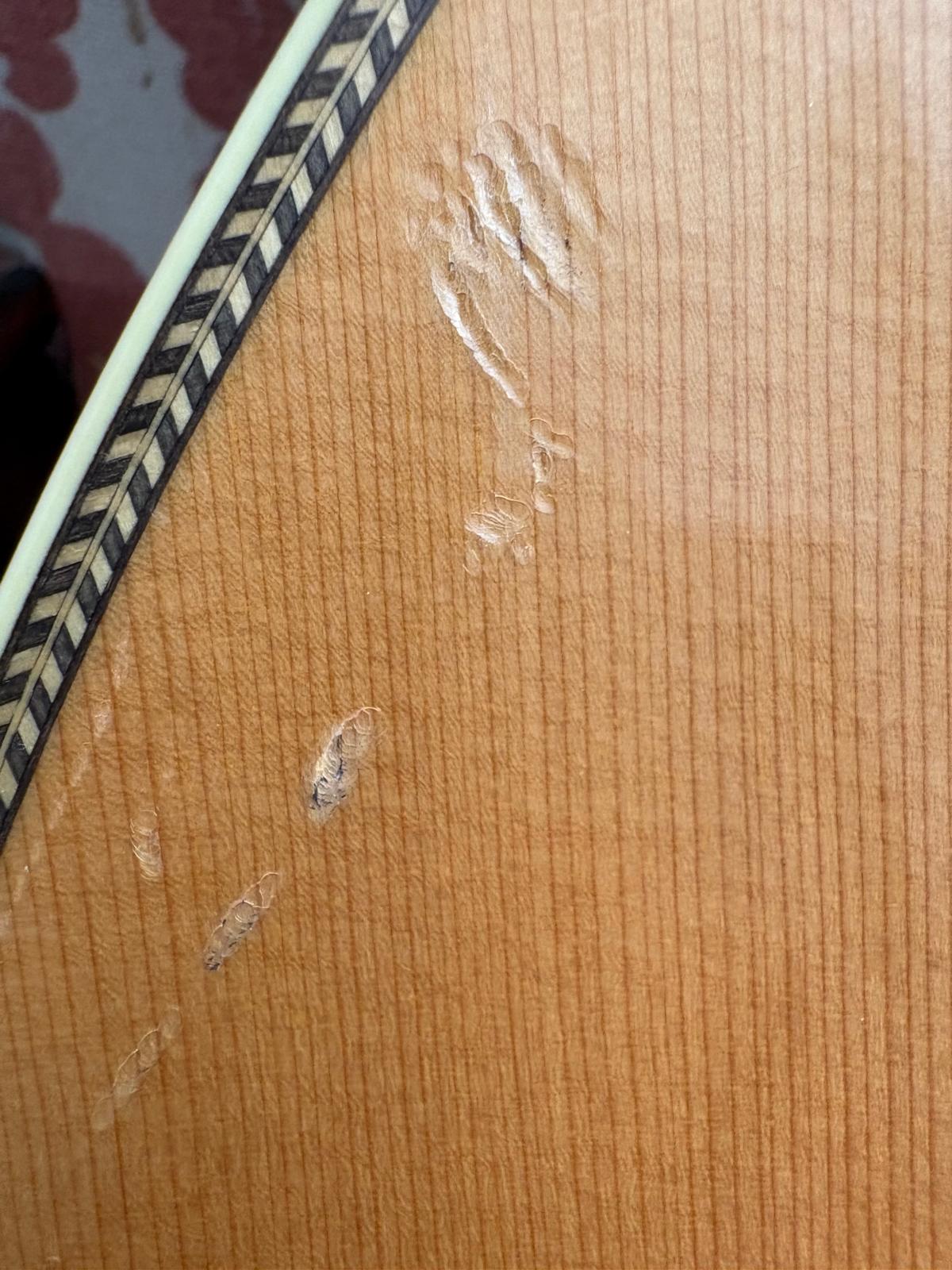
Ding repair on spruce top, 2015 Collings 0002HE #23701. What are y’all reaching for when repairing dents in nitro? GlueBoost fill & finish or drop filling with nitrocellulose? This is a well-used guitar; not pristine and the owner has reasonable expectations that the repair will not be “like it never happened” Bonus question: If there is bare wood, should I seal it with shellac to preserve the color before proceeding to fill?
I've had fantastic results mixing West Systems 406 Colloidal Silica silica with lacquer or epoxy for the drop fill. The silica does not work well with CA. I have also used Tolecut (Eagle Abrasives) spot repair kit* as the abrasive finishing component for most spot finish repairs. The Tolecut kit has two different shapes of hard sanding block, a tear drop and a flat block, that are perfect for spot repairs. The pre-cut Assilex type paper adheres to the blocks by stiction, is washable and the kit comes with a graduated assortment or grits. I usually start with the 800, working downward if required.
I mix in the silica to achieve a syrup consistency and gently work the filler into the defect with the end of a plastic toothpick, although the mixture still self-levels. It's been a welcome experience that either epoxy or lacquer repairs can be done with only one or two drop sessions.
Epoxy is my choice for bare wood, while I favor lacquer for finish repairs. Lacquer requires more dry time to avoid shrink back. Test on scrap to find what works best for your application.
GluBoost is OK for same-day repairs, but it discolors spruce, so you have to seal any bare wood with dewaxed shellac. I find the GluBoost (CA in general) to be prone to air bubbles and brittleness. The GB manufacturer told me it should always be used with the accelerator and for me, the brittleness is a variable with accelerator.
That 406 Colloidal Silica is like the lightest substance on earth and just the air turbulence from opening the box sends it flying, so USE PPE ESPECIALLY A RESPIRATOR.
Thank you! I recently got the Tolecut starter kit and tried it for the first time. I'm a believer!
Interesting comment from GlueBoost about always using accelerator; do you find the accelerator makes it more brittle? Is epoxy harder to sand level to the surrounding (very thin) finish than the GlueBoost Fill & Finish?
Is West System G/flex 650 an appropriate epoxy for this purpose? The colloidal silica may be hard to source here in Mexico. Much information here to absorb. I think I have some testing to do...
PPrivate member
↪ Neil Fradenburgh - Guitarras para los NiñosThe accelerator requirement applies to GluBoost Fill n Finish specifically. The application specialist (I think he was actually the owner) also said with Fill and Finish, apply accelerator under and over a fill due to the addition of plasticizers in the epoxy that retard the curing process. I've just had mixed results, in terms of brittleness, when using Fill n Finish, and the amount and concentration of accelerator seems to affect the brittleness. Also, there is the bare spruce staining, with any CA.
If you have some GB FnF on hand, give it a whirl on scrap. Same goes for the West System G/flex 650 (can't see why it would not be used in your application)- test it on some home-made dents on spruce scrap. I've read that the G/flex 650 is better for gluing oily woods.
PPrivate member
↪ Neil Fradenburgh - Guitarras para los NiñosIf I knew how to message you with this new version of LOOTHGROUP I would toss some Silica in a small packet and mail it to you to try. Believe me, I have 2 lifetimes of supply.....
↪ Private memberThank you for the generous thoughts, but I am currently in Mexico. Shipping/imports can be a real challenge. Small packets of white powder may not be the best idea ;-)
Does the colloidal silica become transparent or translucent when wetted by epoxy?
PPrivate member
↪ Neil Fradenburgh - Guitarras para los NiñosIt turns totally invisible. I did a bit of bench testing on spruce, darker wood and stained wood, all invisable. I did drop fills with epoxy and silica on a build, rosette, bindings, top ding, bindings, and it was all invisible, even under the finish.
PPrivate member
The coating on that 000 is a mixture of a UV poly base and nitro top coats. It seems that many of the deeper spots could benefit from steam applications. I use a paper towel, folded into four layers and saturated with water, along with a soldering iron to raise the crushed grain. After steaming, it's important to let it dry completely.
Depending on how meticulous you want to be, I recommend brushing in an amalgamator to reduce the appearance of the small cracks. While the finish is still soft, you can use a #11 blade to remove the black specks. I typically go "atomic" with Butyl Cellosolve (wear appropriate protection)for this process, but even pure lacquer thinner is an improvement compared to not treating the surface at all.
Drop fills of lacquer may be the best approach for this situation, but it's crucial to build it up slowly with multiple coats over several days to avoid trapping solvents. While the temptation is to fill it level all at once, this can result in a spot that shrinks back long after sanding and buffing. Don't over sand or you'll hit the poly layer and it does not blend with nitro. The two coatings have different sheens, really noticeable.
Thank you for your detailed information! I do not have guitar in hand yet, i will post again with progress/results.
PPrivate member
Hi Neil, Without knowing the specific model, my comments will be somewhat general. If you could reply to the post with the designation from the paper label, that would be helpful.
Guitars produced in 2015 typically have a UV polyester base coat that is about 2-3 mils thick, followed by a top coat of Nitrocellulose Lacquer (Cardinal), averaging an additional 3 mils. There are exceptions to this finish schedule, particularly with guitars from the Traditional Series and bodies made of maple.
A concern when performing touch-ups on bodies with a UV base coat is the risk of sanding or buffing through the thin lacquer coat, which may expose the underlying layer of polyester. I avoid using Gluboost on these models and prefer to airbrush "dry" coats of lacquer, gradually building up the finish, sand and buff.
Unfortunately I did not think to snap a pic when I looked at it. I asked the owner to send one, pending scheduling a repair. It is a substantial ding that is at least partially through to wood, so I am receptive to further insight. I just assumed it was nitro finish.
Also, the guitar has previously been dehydrated, so the grain has imprinted to the surface. I would like to keep the repair area as localized as possible to avoid a huge glossy smooth area on a somewhat weathered guitar. *No airbrush or spray gun ;-(
I added the photo but also poked the "Elders" button. This might be a good discussion because it has a little of everything: dents that might be steamed, broken lacquer, bare wood and as Pat DiBurro mentioned a different undercoat material.
You can use a little bit of water, a paper towel and an iron to coax out the ding - as long as the damage was relatively recent.
As far as using lacquer or CA glue for the finish, I've personally gotten good results with both. If you are worried about matching the color of the original lacquer (especially if bare wood is exposed), I would seriously recommend that you experiment on a piece of scrap wood. Preferably something of the same species and age as whatever is on the guitar. It can give you a good chance to experiment with finishing, sealing, and color matching the original finish without doing any permanent damage to the instrument.


 Lite members only
Unlock video
Lite members only
Unlock video

 Lite members only
Unlock video
Lite members only
Unlock video

 Lite members only
Unlock video
Lite members only
Unlock video


 1 reply


 Lite members only
Unlock video
Lite members only
Unlock video


 Lite members only
Unlock video
Lite members only
Unlock video