I've built a number of classical guitars with an adjustable neck and they seem to gather quite a bit of interest, so i'm currently in the process of looking to refine the design and build. It's quite a simple construction where the neck is held together by string tension and hangs on a pivot. I developed a 3d printed "socket" which acts as the interface between the body and the guitar and allows for some fine tuning of the alignment of t…
PP3 replies
3 replies
LikeShare
PPrivate member
Not really answering your question but I've done a version of the Smallman/Gore joint (I think it's really just Smallman but whatever) on all my guitars (nylon/steel/gypsy). I'm not particularly conc…
Good evening folks,
lately I'm experiencing some sanding methods/mechanism frustration. Can't explain better than look like I'm regressing at doing it.
The only thing changed in my building routine is that I'm currently using a CNC (I haven't used one for some years) for both bodies and necks. I have no problems with necks, but sanding bodies has become incredibly frustrating, specially around the edges.
While I keep improving my c…
Hi everyone,
I'm Martino from Hub of Acoustics, a collaborative project created by luthiers for luthiers. Our goal is to explore and teach acoustic principles that are directly relevant to instrument making.
In 2026, we’ll be running four courses in different parts of the world, all focused on giving luthiers practical tools to better understand and control the acoustics of their instruments.
We’re excited to introduce our very…
I'm fast approaching the finish coating of 2 acousitcs. The sitka spruce tops are really bright. I'd like to tone them down a little and have been scouring the web for methods. Seems like adding amber toner in either the sand sealer or more likely the first set of nitro lacquer coats might be the the ticket. I see Stewmac has a Colortone stain called "Vintage Amber" that can be mixed into the nitro. Anybody have expirience with this pro…
PPP5 replies
5 replies
LikeShare
PPrivate member
Hi Gerry, I recommend spraying a sealer chow it a light scuff and then one more sealer coat. If you are using lacquer, thin some 50% by volume and add TransTint or Colortone. Same dye and some of the…
I cut the fret slots for a baritone guitar build today, so I thought I'd share my method for cutting fret slots, as I think it is a bit unusual.
I radius and profile my fretboard before I cut the slots.
I print out a paper layout of the fretboard, double-stick tape it to the radiused and profiled fretboard, line up the saw by eye to using red hatch marks on the printout, and saw the fret slots with a 3" circular saw that rides on…
PPP5 replies
5 replies
LikeShare
PPrivate member
Awesome! Can you share how you print out the fingerboard layout?
For my current mandolin build, I set out to answer 2 questions: 1. Whether to use physical deflection or frequency analysis to measure stiffness, and 2. How well can I measure wood quality in rough sawn form? (T. Gore says it needs to be planed smooth and rectangular for frequency analysis.) I have 4 different topwood species available for my current build: California Sitka, Englemann, Lutz, and Coastal Redwood. The billets range from 37…
PPP7 replies
7 replies
LikeShare
PPrivate member
Hello Neil, I also measure wood properties when I build mandolins and what you did is very similar to what I have tried, so I'd like to share some thoughts and comments. From my engineer point of view,…
I attach my necks using the LMII/O'Brien jig. No matter the method, there is no guarantee that the neck block and edge of the rim at the top is truly perpendicular to the centerline of the guitar.
I’ve just flossed when things weren’t quite right.
But now I take a long square, place it on the rim at the neck block and measure where the long square aligns on the top seam. I note Bass/Treble deviation at a known point (I use 290 mm).…
I've been trying to figure out an easy to use jig that will allow me to clamp a top and back fast, so that I can use hot hide glue. No way with my spool clamp method I could ever get everything clamped in time. I thought about trying to use pneumatic cylinders with 3D printed perimeter feet, but that seemed very complicated and a lot of work to get something to attach the pneumatic cylinders to. But it kept coming back to me that usi…
Dude. That looks pretty cool? Have you thought about making an arch with an ACME screw to just throw center pressure on it? Like a book binding press etc?
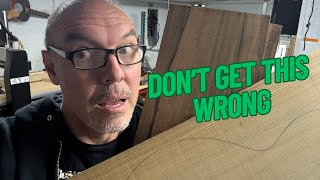
Hey folks, I put together a video showing how I measure the long, cross, and transverse frequencies on guitar top plates before thicknessing, following the Gore method. I also walk through using the calculator I built (based on Trevor Gore’s equations) to get target thickness and track density / young's modulus. Fair warning: the video’s a bit YouTube-y in tone thumbnail faces, a little energy for the algorithm, but the content is genuine…
PPP3 replies
3 replies
LikeShare
PPrivate member
Rick, this is amazing! Thank you so much for creating it and sharing it. I have Trevor’s books but having a calculator to run the equations is really fantastic.
What kind of pore filler do you use? I usually use aqua coat, shellac/pumice or stewmac water based mahogany grain filler. Interested in other methods, including zpoxy.
I have similar thoughts to what you shared. On mahogany, aqua coat looks great. Unfortunately it left white residue in pores when I tried it on walnut. Now I’m curious about gluboost, thanks for the t…
I rarely use pickguards on my builds, as most of my guitars are intended for fingerstyle players. That said, I occasionally need to install one, and I've yet to find a cutting method that consistently meets my quality standards. I’ve experimented with several techniques for cutting clear pickguard material, but the results are always somewhat disappointing. Using a brand new X-Acto blade gives a reasonably clean cut, but there's almost a…
PP3 replies
3 replies
LikeShare
PPrivate member
I use raw pickguard sheet material, apply 3M 468MP Double Sided Adhesive Transfer adhesive sheet and trim to rough size with scissors or blades, depending on the pickguard material. I then attach to…
I've been testing all my top and bracewood to find the best combination of stiffness and density, optimize plate thickness, etc. I started with Nicoletti's spreadsheet which calculates both stiffness and density, but since I was also testing deflection, I decided to compare the flexural modulus using that method (with the formula from T. Gore's book) on the same plates and bracewood. Unfortunately, I'm having trouble getting a satisfa…
PPP7 replies
7 replies
LikeShare
PPrivate member
Hello Neil, as you rightly pointed out, they are all in reasonable range for the species, but do not perfectly correlate (at least, not all of them). In my experience, the deflection method is is not v…
I have built a steel string guitar that has an annoying high pitched pulsing overtone. The guitar is an x-braced OM style with a thicker depth (more in line with a dreadnaught depth). I have built several of these that do not have the annoying overtone, so I don't think its the specific shape that is causing it. The overtone occurs when the note B2 is played on the G string, 4th fret. Interestingly, it does not occur when the open B stri…
A bit hard to tell from your description, but is what you are describing as an oscillation a beat frequency? If so, it is possible you have multiples of two resonant frequencies that are nearly colli…
I am setting up a compressor in my shop almost entirely to spray finishes. I've looked at a lot of youtubes and am now more confused than when I started. I'm currently using a HVLP system but I want to set up a compressor and I know nothing of the filters I see and now I'm learning there is a need to cool the air before spraying. I understand the methods of cooling I see but do I need all this to spray just guitars. I have a 6SCFM…
P1 reply
1 reply
LikeShare
PPrivate member
I solved all of my air line contamination issues with this rig. First step is a basic moisture and oil trap, second is a desiccant based moisture remover, third stage is a high end (very small partic…
Two pieces of maple, each of which were measured beforehand and then cut up and epoxied back together to keep things as consistent as possible. Even the orientation of the grain was the same to avoid any impact of vertical vs horizontal grain lines. The plain maple had one layer of 300gsm 12k unidirectional carbon fibre between each piece, the flame maple had two per lamination, which may be why it sees a smaller gain afterwards? Lots m…
Thanks for this! I worked with FRPs, carbon fiber, etc. for years as a shipwright and never came across colored product like the Hypetex you mentioned. Very cool! Hypetex makes flax-based and carbon f…